.jpg)
Fresco-covered haveli walls in the Shekhawati region
Imagine walking through a small dusty town in rural Rajasthan, turning a corner, and finding an entire building covered in paintings — floor to roofline — depicting gods riding chariots, merchants sailing ships they'd never seen, and British soldiers arriving on steam trains that hadn't yet reached the region. That's Shekhawati.
The Shekhawati region, spanning the Jhunjhunu and Sikar districts of northern Rajasthan, contains over 2,000 painted havelis built between the 18th and early 20th centuries. UNESCO has called it "the world's largest open-air art gallery." But unlike galleries with velvet ropes, these masterpieces crumble a little more each monsoon season.
Who Were the Chiteras? The Artists Behind the Walls
The frescoes weren't painted by celebrated maestros. They were created by chiteras — hereditary artisan-painters from the Kumhar (potter) and Chhipa (fabric printer) communities who passed techniques down through generations.
A chitera's training began in childhood. Boys apprenticed with their fathers from age 8-10, learning to grind mineral pigments, prepare lime plaster, and compose scenes from memory. There were no sketches or templates — a master chitera held entire epics in his head and painted them freehand onto wet plaster.
The Fresco Technique: Painting While the Wall Is Still Wet
Shekhawati frescoes use the true fresco (buon fresco) method, the same technique Michelangelo used in the Sistine Chapel:
- Base preparation: Multiple coats of lime plaster (araish) mixed with jute fibres were applied to the wall. The final layer used fine marble dust for a smooth, almost glowing surface.
- Wet painting: Pigments were applied while the plaster was still damp. As the lime dried, it formed a chemical bond with the pigment — essentially locking colours into the wall itself.
- Mineral pigments: Colours came from the earth — yellow ochre, red sandstone dust, indigo from plants, lampblack from oil lamps, and green from copper compounds. These natural pigments are why 200-year-old frescoes still show vivid colour today.
The catch? Artists worked against the clock. Once plaster dried (typically 6-8 hours), no corrections were possible. Every brushstroke was permanent and final.
What Do the Frescoes Actually Show?
This is where Shekhawati frescoes become extraordinary. They're a visual diary of an era — part mythology, part social history, part advertising.
1. Mythological & Religious Scenes
The most common subjects come from Hindu epics. You'll find entire walls dedicated to:
- Krishna Leela — episodes from Lord Krishna's life, especially the Ras Leela (divine dance) and his lifting of Govardhan Hill
- Ramayana panels — sequential battle scenes from the epic, often wrapping around entire courtyard walls
- Ganesha and Lakshmi — placed above doorways for auspiciousness
- Ragamala paintings — musical modes depicted as scenes of romance, seasons, and emotions
2. The "Modern" World Through Merchant Eyes
This is where things get fascinating. Shekhawati's Marwari merchants traveled to Bombay, Calcutta, and even London for trade. They came home with stories of marvels they'd seen — and commissioned chiteras to paint them on their havelis.
The result? Painters who had never seen a train, a car, or a European depicted them from verbal descriptions:
- Steam trains — often with impossible proportions, sometimes flying through the sky alongside birds
- Hot air balloons and early aeroplanes — imagined from stories, painted with creative liberty
- Gramophones and telephones — depicted being operated by figures in traditional Rajasthani dress
- British soldiers and Europeans — painted with blue eyes, top hats, and sometimes riding bicycles alongside camels
- Motor cars — one famous fresco in Mandawa shows a car being pulled by horses, suggesting the artist couldn't quite grasp self-propulsion
These "modern" frescoes are time capsules of a society processing industrialisation through the lens of rural Rajasthan. They're often humorous, always sincere, and historically priceless.
3. Daily Life & Social Scenes
Many frescoes document everyday life: wedding processions with musicians, women drawing water from wells, camel caravans on trade routes, festivals with fireworks, and merchants weighing goods on brass scales.
4. Erotic Frescoes
Yes, they exist — particularly in the inner private quarters (zenana) of havelis. Inspired by the Kama Sutra tradition, these were considered auspicious for fertility and marital harmony. Many were painted in upper-floor rooms away from public view.
Where to See the Best Frescoes
Nawalgarh — The Richest Collection
Nawalgarh has the highest density of well-preserved havelis. Must-visit:
- Poddar Haveli Museum — Restored and maintained, this is the best introduction. Entry ₹100. Guides available.
- Morarka Haveli Museum — Stunning floral and mythological frescoes with excellent restoration work.
- Aath Haveli — A cluster of eight connected havelis with diverse fresco styles spanning generations.
Mandawa — The Most Photogenic
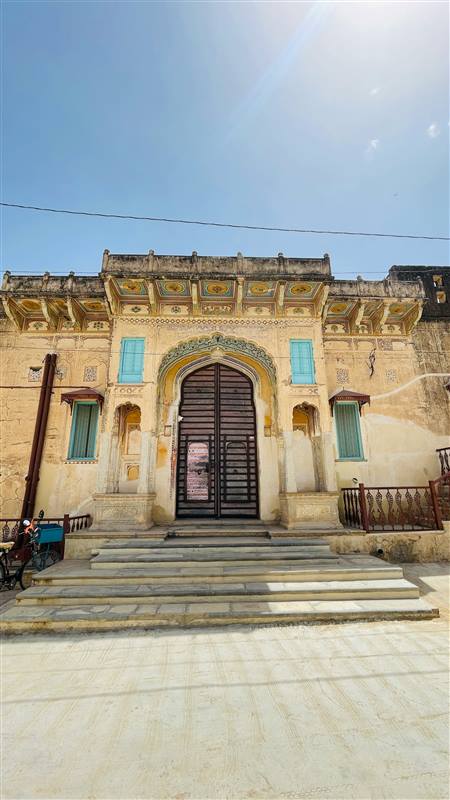
Mandawa is the most tourist-accessible town with Castle Mandawa as its anchor. Key havelis:
- Harlalka Haveli — Famous for its painted "Venice" scene and a fresco of the Wright Brothers' aircraft
- Murmuria Haveli — Elaborate scenes including trains, cars, and a gramophone
- Goenka Double Haveli — Two-storey frescoes with mirrors embedded into painted elephants
Fatehpur — The Most Atmospheric
Less visited than Mandawa, Fatehpur's havelis feel more discovered. Look for:
- Nadine Le Prince Cultural Centre — A French artist's rescued haveli turned gallery and cultural space
- Jagannath Singhania Haveli — Extraordinary preserved frescoes with vivid blues and greens
Ramgarh — The Grand Scale
Ramgarh's havelis are among the largest in Shekhawati, built by the powerful Poddar family. The town feels like a forgotten capital — grand facades facing empty streets.
Why These Frescoes Are Disappearing
Shekhawati faces a slow-motion cultural catastrophe:
- Abandonment: When Marwari merchants moved to Mumbai and Kolkata, they left havelis to caretakers or relatives. Many stand empty, locked, and decaying.
- Weather: Monsoon rains seep through cracked roofs. Each season dissolves more plaster and pigment. Some havelis have lost 50-80% of their original frescoes.
- Neglect and vandalism: Without protection, walls get whitewashed for "renovation," frescoes get covered by electrical wiring, and occasionally panels are chipped off by thieves.
- Ownership disputes: Many havelis have 20-30 descendants claiming ownership across multiple cities. Legal tangles prevent any single party from investing in restoration.
A handful of organisations — notably the Friends of Shekhawati and the Nadine Le Prince Foundation — work on preservation, but the scale of loss dwarfs available resources.
How to Experience the Frescoes as a Visitor
Practical Tips
- Hire a local guide: Many havelis are locked. A guide (₹500-800 for a half-day) knows caretakers, carries keys, and explains iconography you'd otherwise miss.
- Best light: Morning (8-11 AM) for exterior frescoes. Midday works for shaded courtyard paintings.
- Photography: Freely allowed in most havelis. Bring a wide-angle lens for courtyard shots and a macro for fresco details.
- Footwear: Remove shoes before entering inner chambers (it's respectful and protects fragile floors).
- Time needed: One town takes 3-4 hours to explore properly. Plan 2-3 days to cover Nawalgarh, Mandawa, and Fatehpur.
What to Look For
Train your eye for these details:
- Border patterns: Geometric and floral borders frame scenes — they indicate the fresco's era and the chitera's school.
- Blue pigment: The most expensive colour. Its use indicates the patron's wealth.
- Layering: Some walls have frescoes painted over older frescoes — you can see earlier layers where the top layer has peeled.
- European elements: Cars, planes, top hats, and angels mixed into otherwise traditional Hindu scenes are signature Shekhawati.
The Bigger Picture: Art as Legacy
The Shekhawati frescoes are more than decoration. They're the visual autobiography of an entire merchant community — a people who quietly funded the industrialisation of modern India (the Birlas, Goenkas, Poddars, and Bajajs all trace roots to Shekhawati) and documented their world in paint before leaving it behind.
Walking through a frescoed haveli, you're standing inside someone's pride, ambition, faith, and curiosity about a changing world. These walls are their story. And unless we pay attention, the monsoons will wash them away.
Want to see these frescoes firsthand? Our Shekhawati itineraries are designed specifically for international travelers who want to explore this art at a comfortable pace with local guides. Get in touch to plan your trip.